Mechanical Design & Manufacturing
Projector
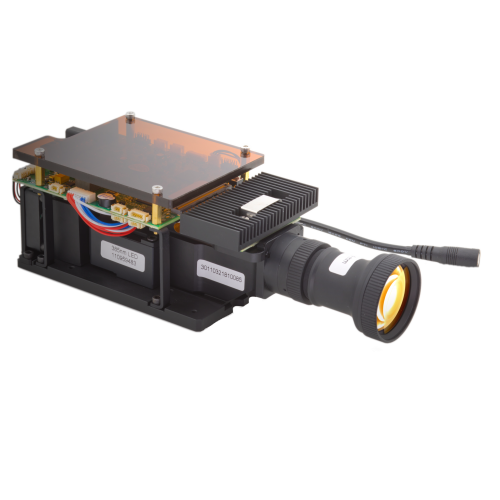
We use the Wintech PRO1470 Projector with an LED wavelength of 405nm and a lens working distance of 114mm.
Cost: $1799.00
Frame
The frame is constructed out of 80/20 aluminum extrusion (20mm T-slot structural framing) and held together with T-nuts, joining plates and brackets. This is a cheap option which also lends itself well to adjustability.
Optics Module
The optics have been modularized to allow for more efficiency in alignment – the projector and lenses are mounted to a modular frame section.
Lenses

Our system uses two Edmund Optics lenses which are 50mm in diameter with focal lengths of 125mm. They are uncoated and plano-convex. According to Knight Optical, placing two plano-convex lenses such that they both face convex-in creates a condenser. By placing the projector at the lens focal length, we are able to collimate the light with the first lens and then recreate the image at our desired location with the second in the series. The back focal length of these lenses is 118.39mm, which closely matches our projector’s lens working distance of 114mm.
Cost: $46.50 x 2 = $93.00
Lens Mounts
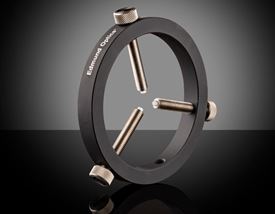
To attach the lenses to our frame, we selected corresponding mounts. These will attach onto the frame with a 1/4’’-20 post. They offer 2-axis adjustment via three screws.
Cost: $68.50 x 2 = $137.00
Rotation Stage
The rotation stage is a 3D-printed assembly which incorporates a gear train, linear stage, and vial holder. This is how the vial is held and rotated during the printing process, with built-in fine lateral adjustment for alignment purposes. Alignment can also be adjusted by loosening the thumbscrews to slide the vertical extrusion post back and forth. We use a 2-1 gear ratio with 3D printed gears.
Motor
We used a Pololu motor for prototyping, which meets our torque requirements and can thus be integrated into our final design.
Linear Stage
This 3-D printed piece makes use of a dovetail joint plus a nut, bolt, and spring to make small adjustments to vial alignment rather than sliding the entire vertical extrusion back and forth. This is an experimental part of our rotation stage which is under development.
Vial Holder
The vial holder extends continuously downwards from the secondary gear and uses crush ribs to ensure a secure press-fit.